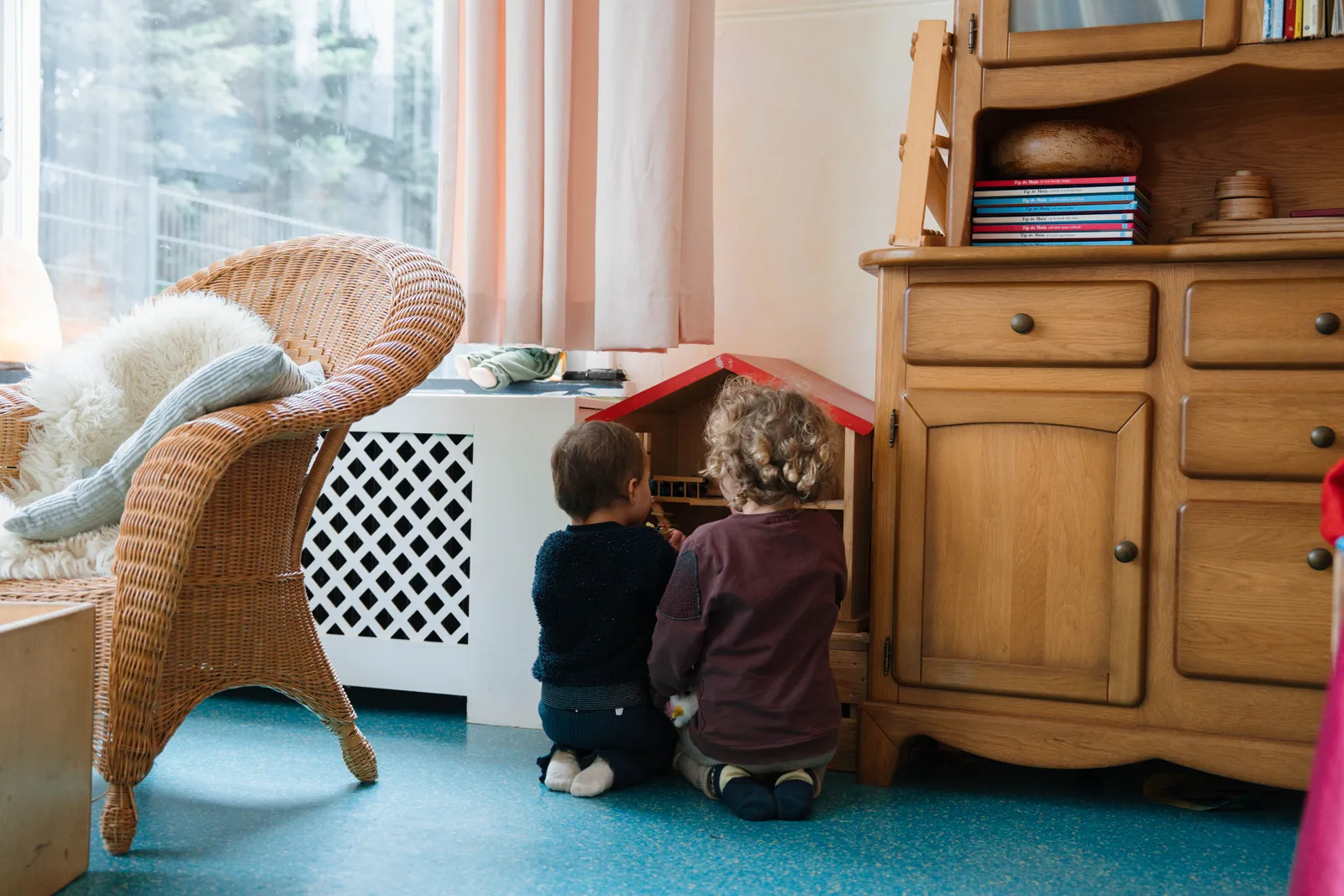
Each group room is set up like a home. This gives the children a sense of security, clarity and trust.
Our childcare staff meet at least the national training requirements for childcare, and most of them have a higher qualification. We select them for their expertise, experience and creativity, among other qualities.
All the food we serve is organic or biodynamic.
Every child is unique, with their own quirks, talents and qualities. We let children discover things for themselves, without an adult filling things in for them. Where needed, we encourage them and give them a little support, but never by giving instructions. This way, children build self-confidence and self-respect, develop a positive self-image and are free to become who they are.
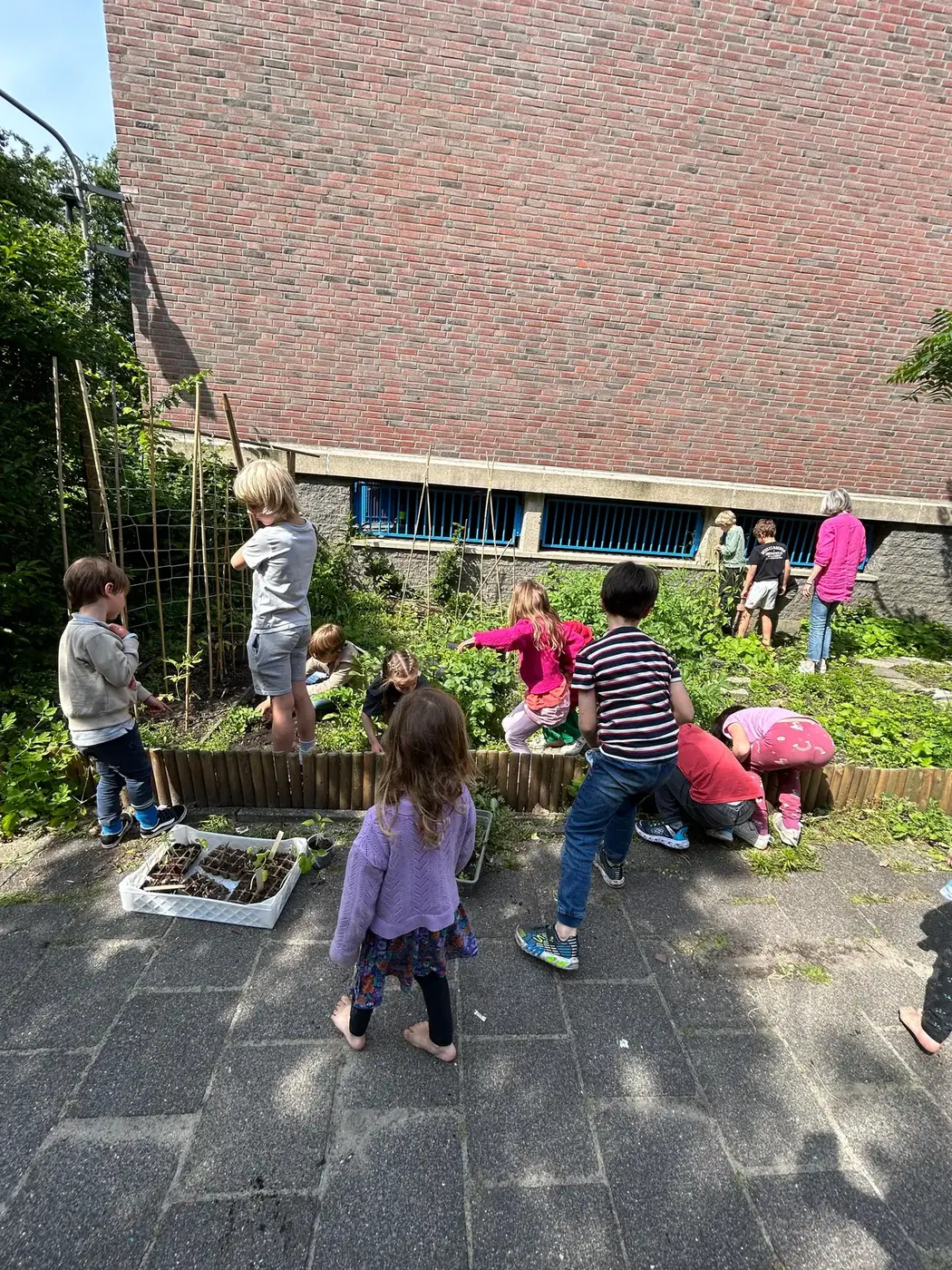
Outdoor play is part of our daily rhythm, whatever the weather. When it rains, the children still go outside for a while in their raincoats and rain boots. Only when there is a storm with a code red weather warning, or when the garden is very slippery, do the children stay indoors.
Jacqueline
Leidingevende Rijksstraatweg
Functie: Leidinggevende
Since 2020, I have really enjoyed working as a manager at de Wonderberk on Rijksstraatweg. My love of childcare began much earlier: in 1994, I worked with a group of children for the first time. There I discovered how wonderful it is to help young children along in their development, and to support families during such a special stage of their lives. Later I moved into a management role, but that feeling has always stayed with me.
When I walked into de Wonderberk, it truly felt like coming home. It reminded me of the organisation where I started in 1994: small-scale, with a warm heart for children and parents, and a team working together to build a beautiful place where children can play, discover and grow.
What moves me every day is the dedication of my colleagues. They work from the heart, with a real passion for education and anthroposophy. You can see that care in the little things: a calm rhythm, a loving look and room for wonder.
I am proud to be building such a lovely place together with this team.
Victor
Director/Founder
Functie: Directeur/Eigenaar
It all started with a wish many parents will recognise: a place for our own children where we could leave them with complete peace of mind. A childcare centre based on anthroposophical principles, with calm, attention and room to simply be a child.
In 2007 we set to work on that idea. It took patience and perseverance, but five years later the time had come: de Wonderberk opened its doors on the Rijksstraatweg, in a beautifully renovated former parsonage in Haarlem-Noord. My own children were just in time to enjoy it, which makes it all the more special to me.
What do I work for every day? That de Wonderberk stays true to its anthroposophical character, that we remain a healthy and independent organisation, and above all that de Wonderberk feels like a second home for every child.
Wendy
Cluster Manager, Out-of-School Care & Castricum Day Nursery
Functie: Leidinggevende
Together, we create a lovely environment in which children and staff alike feel at home and have room to grow.
Every day, I work with enthusiasm and dedication for de Wonderberk. As cluster manager, I am responsible for all our out-of-school care groups, spread across four locations, and for the day nursery in Castricum. My work includes the day-to-day organisation, developing our teams and safeguarding the quality of our care.
I believe in the strength of people and of self-managing teams. I think it is important to give staff trust, room and responsibility, and to support them in their development. I also value connection, open conversations with colleagues and, of course, a healthy dose of humour.
At de Wonderberk, it is never boring and no two days are the same! Besides all the big and small developments at the locations and within the teams, it is the little moments that make my work so enjoyable. A spontaneous hug, a treat a child has made themselves, a handmade ticket for a play at out-of-school care, or now and then being the ‘teacher’ when picking children up from school or visiting a location. Those are the moments that make my day!
A day at the day nursery
At the day nursery, the day has a set structure in which activity and rest alternate. These familiar moments give the children something to hold on to. Babies follow their own rhythm, which we agree on together with the parents.
The morning
The groups open at 7:30 am, and children can be dropped off until 9:00 am. We welcome each child personally. The first children often watch in the kitchen as the food for the day is prepared, and then there is time for free play. At around 9:10 am, the staff invite the children with a song to tidy up and come to the table. After our morning verse, we eat fruit and drink water or lukewarm tea. Sometimes we sing a little longer, read a story or play a table game.
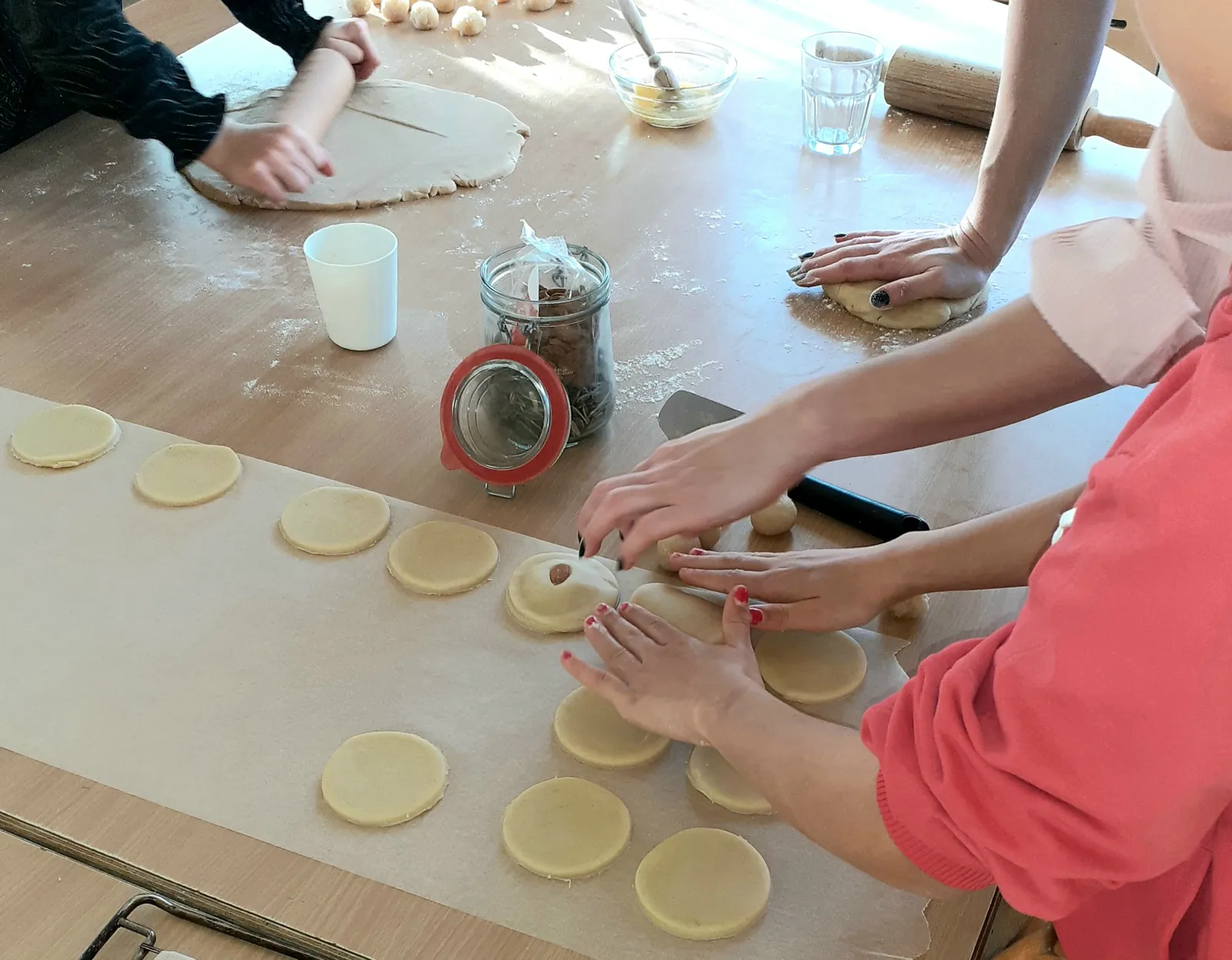
After that, the children have their nappies changed or go to the toilet. Then we go outside as much as possible; when it rains, we put on rain gear. If we stay indoors, there is an activity such as cooking, baking, painting, drawing or singing, or the children help with the housework.
Lunch and afternoon rest
At 11:30 am, we sit down at the table and sing our mealtime verse. We eat bread, and when we have cooked, also soup, a toasted sandwich or pancakes. After the meal, we give thanks. From 12:30 pm, after a nappy change, the children rest or sleep for a while. Between 2:30 and 3:00 pm, they wake up one by one. While they are changed and dressed, each child gets a moment of undivided attention.
The afternoon
At around 3:15 pm, we sit down at the table again for a snack. After that, there is time for an activity or we go outside once more. Children can be picked up from 4:30 pm, and at pick-up we tell parents how their child’s day went. After 5:00 pm, the children play with few or no toys. The groups close at 6:00 pm.
Babies
Babies have their own rhythm of sleeping, feeding and playing. One baby is having some food, another a bottle, while yet another explores the room on a soft rug. We put babies on the floor as much as possible so they can move freely, and we sing seasonal songs throughout the day.
Growing up step by step
At de Wonderberk, we take each child’s stage of development into account. For toddlers and preschoolers, the emphasis is on imitation, sensory experiences and play: they learn by doing and experiencing. For older children, such as those in classes 4, 5 and 6, the focus shifts towards working together, taking responsibility and discovering the world and themselves in a more conscious way.
Babies
Babies need calm and regularity above all. In our baby groups, we follow each child’s own eating and sleeping pattern as much as possible, so that the step between home and de Wonderberk stays small.
Toddlers
Toddlers live in a world of imitation. They help knead bread dough, chop vegetables for the soup or water the plants, and in this way they learn by doing. The toys are simple in form and made of natural materials, giving their imagination plenty of room. At first toddlers mostly play alongside each other, and later more and more together. A steady daily rhythm, with circle time, songs and little stories, gives them calm and confidence.
Preschoolers and young schoolchildren
After a day at school, children need to choose for themselves what they want to do. That is why free play is at the heart of what we do: building dens in the garden, playing in the sandpit or the doll’s corner, or curling up quietly on the sofa with a picture book. A rich imagination, fed by stories and the children’s own play, is our starting point. We deliberately have no computers or television.
Older children
For children in classes 4, 5 and 6 (around ages 9 to 12), there are play materials suited to their age, such as books, board games, tools and craft materials. They can join in activities such as cooking, baking, making music, painting and clay modelling. In doing so, they learn to work together and take responsibility, and they discover the world and themselves in a more conscious way.
Healthy, wholesome food
At de Wonderberk, food is more than just fuel: it contributes to a child’s healthy and harmonious development. Our meals are vegetarian, made with fresh, unprocessed and organic produce that suits the season. We eat together at the table in a calm atmosphere, and we start each meal with a song.
Fresh, organic and vegetarian
We use as few processed products as possible, so that children get to know the pure taste of nature. Vegetables, fruit, grains and pulses form the basis. Light, easily digestible food suits young children, and eating vegetarian is also a sustainable choice. What we eat follows the seasons: in autumn, for example, we are happy together with the pumpkins we turn into soup.
Together at the table
The children eat at set times and always at the table. Our childcare staff eat with them and set a good example, because young children learn by imitation. Within our healthy range of food, children decide for themselves what and how much they eat. They don’t have to clear their plate, but we do encourage them to eat and drink enough.
Helping out
Children regularly help bake bread, make soup and lay the table. We make the soup fresh in the group from organic vegetables, without added salt. The seasons and festivals also have their own dishes, such as pancakes or pumpkin soup. In this way, children experience food as something valuable and learn respect for where it comes from.
What we serve
At the day nursery, the children have fruit in the morning, bread and soup at lunchtime and a small snack at the end of the afternoon, such as a lentil cracker. They drink water, weak herbal tea without sugar and, at lunch, milk or buttermilk. We don’t serve squash, cordial or fruit juice. At out-of-school care, there is a snack with bread and raw vegetables after school, and a fruit moment at the end of the afternoon, often with a story.
Babies
Babies have their own feeding schedule. Parents bring expressed breast milk or formula in powder form. We always start first foods in consultation with the parents. Babies first get to know single flavours, so that they learn to recognise and enjoy them in their pure form.
Allergies, beliefs and birthday treats
We take allergies, intolerances and religious beliefs into account. We discuss any special requirements at the intake meeting. If our food doesn’t suit a child, we ask parents to bring a good alternative. For birthdays, we ask for a healthy treat without added sugars or fats, and no small gifts. The celebration is mainly about the song, the birthday crown and extra attention for the birthday child.